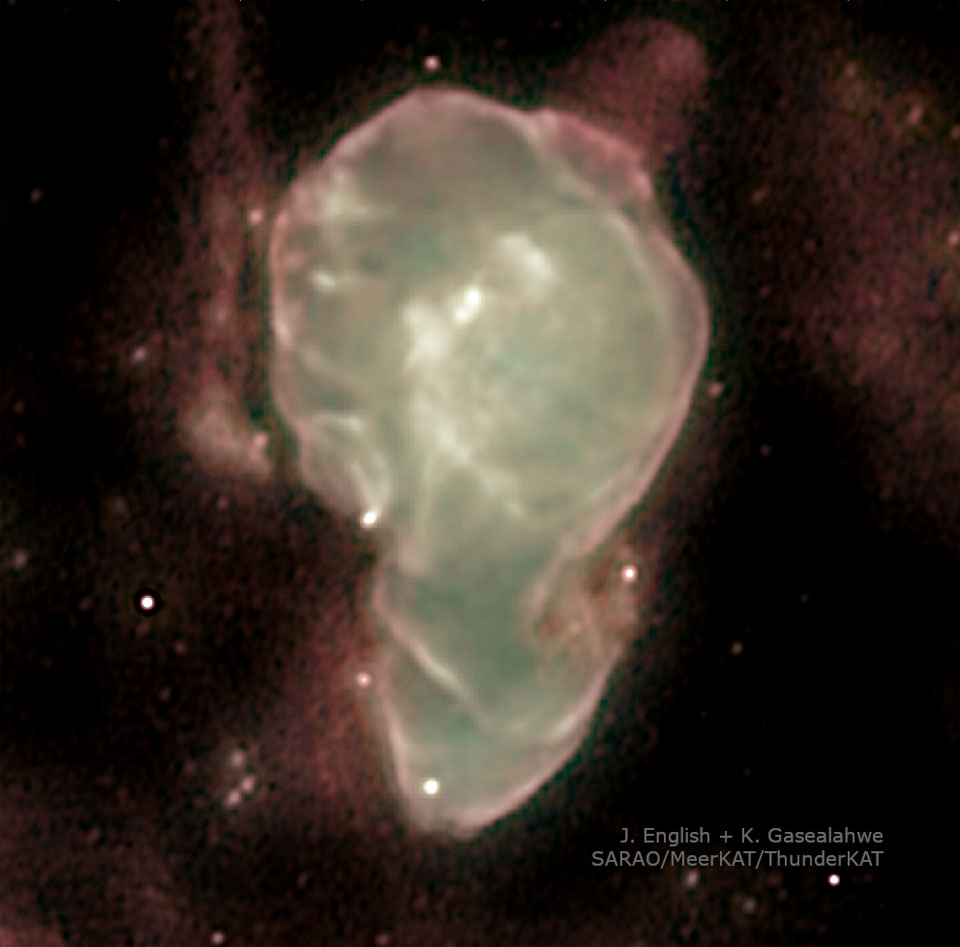
Cir X1: Jets in the Africa Nebula
How soon do jets form when a supernova gives birth to a neutron star? The Africa Nebula provides clues. This supernova remnant surrounds Circinus X-1 , an X-ray emitting neutron star and the companion star it orbits. The image, from the ThunderKAT collaboration on the MeerKAT radio telescope situated in South Africa , shows the bright core-and-lobe structure of Cir X-1 ‘s currently active jets inside the nebula. A mere 4600 years old, Cir X-1 could be the “Little Sister” of microquasar SS 433 *. However, the newly discovered bubble exiting from a ring-like hole in the upper right of the nebula, along with a ring to the bottom left, demonstrate that other jets previously existed. Computer simulations indicate those jets formed within 100 years of the explosion and lasted up to 1000 years. Surprisingly , to create the observed bubble, the jets need to be more powerful than young neutron star s were previously thought to produce. Open Science: Browse 3,700+ codes in the Astrophysics Source Code Library Image Credit: J. English ( U. Manitoba ) & K. Gasealahwe ( U. Cape Town ), SARAO , MeerKAT , ThunderKAT ; Science: K. Gasealahwe, K. Savard ( U. Oxford ) et al. ; Text: J. English & K. Savard https://science.nasa.gov/image-article/apod-2025-september-3-cir-x1-jets-in-the-africa-nebula/