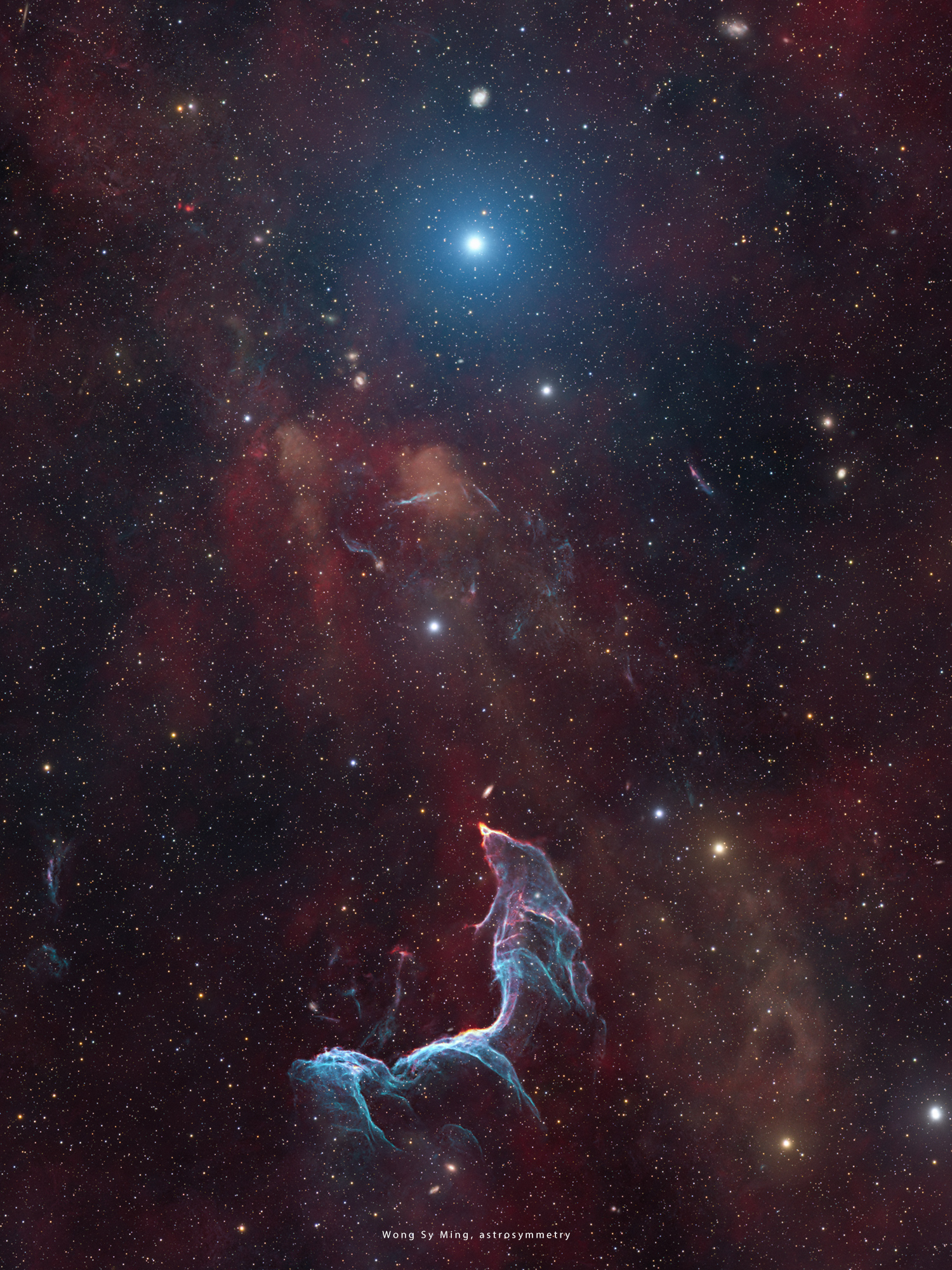
The Mermaid Nebula Supernova Remnant
Could the Little Mermaid turn into stardust instead of seafoam? It would seem so in this beautiful nebula . The featured image shows the Mermaid Nebula , also known as the Betta Fish Nebula, which is part of the G296.5+10.0 Supernova Remnant . The blue color visible here originates from doubly ionized oxygen (OIII) , while the deep red is emitted by hydrogen gas . Estimated to be located a few thousand light-years away and about 10,000 years old, this nebula was formed when a massive star exploded as a supernova . It left behind a peculiar pulsar , a young radio-quiet neutron star that spins around about twice every second . The bright stars shown in the image are unassociated with the nebula. The pulsar can be detected in the X-rays but it does not have a confirmed detection in the optical ( visible light ) so far. As a result, the pulsar itself is not visible in this image. Image Credit & Copyright: Data acquisition: Sy Ming Wong; Processing: Guangyan Gao Text: Cecilia Chirenti ( NASA GSFC , UMCP , CRESST II ) https://science.nasa.gov/image-article/apod-2026-june-11-the-mermaid-nebula-supernova-remnant/