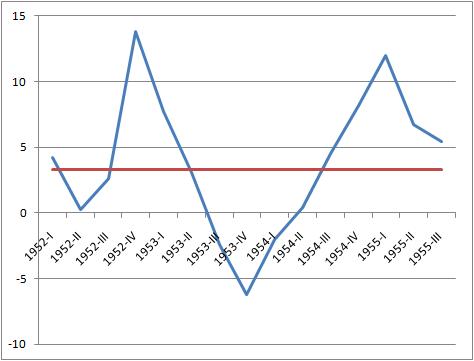
Recession of 1953
The recession of 1953 was a period of economic downturn in the United States that began in the second quarter of 1953 and lasted until the first quarter of 1954. The total recession cost roughly $56 billion. It has been described by James L. Sundquist, a staff member of the Bureau of the Budget and speechwriter for President Harry S. Truman, as "relatively mild and brief." The 1953 recession is an example of a V-shaped recession, with a sharp three quarter decline that is followed by a sharp recovery. July 1953 – May 1954 · 10 months Peak unemployment: 6.1% (September 1954) · GDP: −2.6% S&P 500: +20.9% over the recession After a post-Korean War inflationary period, more funds were transferred to national security. In 1951, the Federal Reserve reasserted its independence from the U.S. Treasury and in 1952, the Federal Reserve changed monetary policy to be more restrictive because of fears of further inflation or of a bubble forming. Dates: the National Bureau of Economic Research's business cycle chronology. Wiki link Wiki link